
6 tips to get better at drawing


I can't say that I'm the best artist out there, but I can certainly draw better than when I started this sketch blog. I've read a lot of advice about getting better at drawing over the years. Some advice has been very helpful and some advice just hasn't worked for me. I want to share just a couple of tips that have helped me improve, particularly over the last four or five years. 1. Draw a lot. How much is a lot? Malcom Gladwell says its takes about 10,000 hours of doing something to become an expert at it. (I recently did a back-of-the-napkin calculation with my father and we figured he had done over 80,000 hours of surgery!) So the more you do every day, the faster you'll get good. In 2004, I attended my first San Diego Comic Con, where I nervously showed around my sketchbook to artists I admired. One of these artists was Paul Davies, who recommended that I fill up one sketchbook a month, at minimum. I did just that, several months over, and was amazed at how quickly I progressed over that time. I also recommend that if you have the means, to get a job where you draw. It's much easier to get in a lot of hours of practice when 8 or more of them are guaranteed everyday.

2. Slow and Steady. Especially when learning to do cleanup, whether it be with pencil, brush or crow quill, go slowly. It's just like practicing a musical instrument. You start as slowly as you can without making mistakes, then you speed up. Go as slowly as necessary to have control over what you're doing on the page. This is particularly important when trying to ink ellipses and other curves freehand. While it's best to sketch an ellipse in a single quick stroke, I've never seen an artist I admire ink an ellipse that way. Most will carefully and deliberately chunk out the ellipse with smaller controlled ink strokes.
Watch how Jake Parker does it:
Inking Missile Mouse from jakeparker on Vimeo.
3. Learn from the best. Another musical analogy. I met a guy once who played the violin in high school. His music teacher gave him this piece of advice: If you want to be first chair, don't set your sights on first chair, set your sights on the best violinists in the world. Particularly with the ubiquity of information on artists available on the internet, there's no reason you can't learn from the best. Find the artists you admire through google or twitter. Start a correspondence with them. Ask them questions. You'll find many are generous and willing to help. Read what they have to say on their blogs, and watch their video tutorials. The recently launched ArtCast Network is a great place to do this. If you can't get in touch with an artist you like, then copy their work. Download, or buy high resolution images of their art and practice making exact replicas. When I started learning how to ink, I would download hi-res images of Frank Cho's art, convert it to blue-line, print it out on Bristol and ink over it trying to copy his line quality. The same can apply to any artist you want to replicate. Look at their art, study it closely and figure out how to replicate it. Just one caution: make sure and give the original artist credit if you show your studies to anyone else.
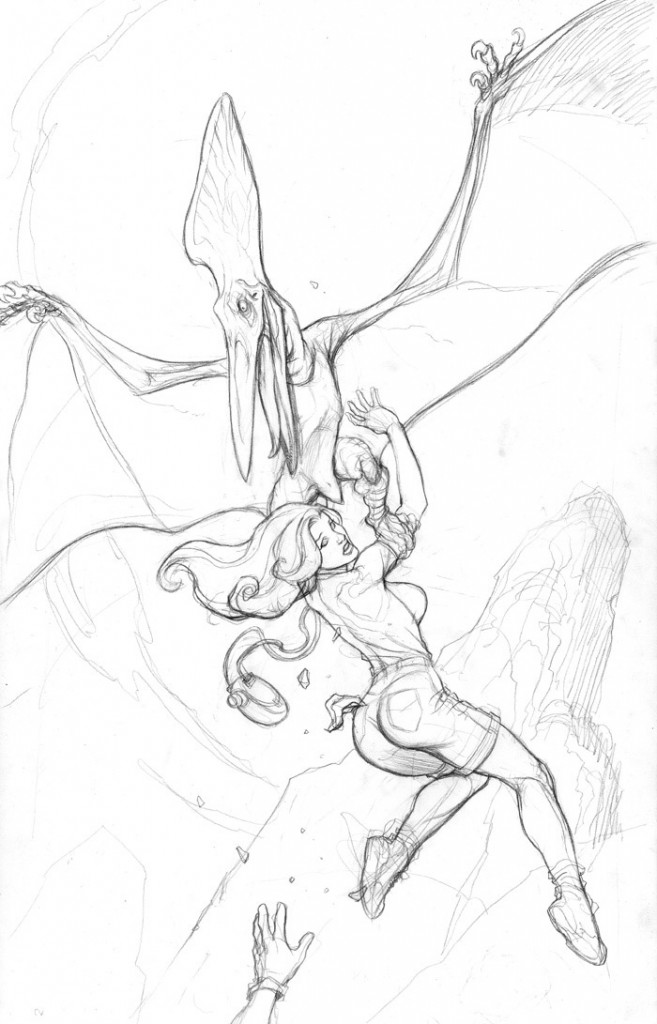
4. Fix it until it's right. When working on a difficult piece, redraw it until you get it right. Especially if you're starting out, I recommend using mechanical pencils with a good eraser. They erase easily, and you can re-work and readjust a drawing until you get it right. Set a high standard f0r yourself and work to achieve that with every piece. Look at your drawing in front of a mirror, or flip it around and hold it up to the light. Seeing it in reverse will reveal problems in the drawing. Don't take this suggestion too far. If you're really hitting a wall, abandon the drawing, or start over. It's more important to draw a lot than get stuck on one drawing.


5. Study the Fundamentals. Study the best books and videos on perspective, construction, anatomy, rendering and color theory. I highly recommend the resources found at Gnomon Workshops (Some of the best stuff I found on Gnomon were tutorials by Feng Zhu and Scott Robertson on how to draw a straight line freehand.) Go to live figure drawing classes, weekly, if possible. Go to the zoo every week, or more, if you want to learn to draw animals. Ernest Norling's Perspective Made Easy will teach you everything you need to know about perspective. Preston Blair's Cartoon Animation is the best place to get started with construction. I'm still really searching for is a good book on anatomy. I own several books on anatomy, but none that really satisfies me. If anyone has any recommendations, please contact me.

UPDATE July 16, 2013

I've since found a handful of anatomy books that I really like. Michael Hampton's Figure Drawing: Design and Invention is probably the best place to start. It's a great introduction to construction and drawing with form (I might even put it ahead of Preston Blair) and it does a fantastic job of breaking down and abstracting the human form in a logical and methodical way.
I'd also recommend Frederic Delavier's Strength Training Anatomy. It's a fantastic reference for anatomy in motion with call-outs to muscle groups and other landmarks with every image.
Last, I'd recommend Elliot Goldfinger's Human Anatomy for Artists - an exhaustive technical reference that leaves no stone un-turned.
6. Repeat until you die. This is probably the most important step. There's always something new to learn. Thank God! One of the greatest joys of drawing is having those break-through moments that come from constantly challenging yourself. Keep at it. The fun is in the process, not in the prize.
Like what you just read?
If so, sign up below to receive free tutorials and updates including my Foundations of Dynamic Linework video tutorial.